If you run a farm, you already know irrigation is not just about getting water from one place to another. It affects crop health, labor, fuel, power bills and your final yield. That is why so many growers ask the same thing: what is the best irrigation sprinkler system for Modern irrigation systems farming?
The honest answer is this: there is no one perfect system for every farm. The best system depends on your land size, crop type, field shape, water supply and budget. In general, modern farms in the United States use pressurized irrigation systems such as sprinkler systems and micro or drip irrigation because these methods can improve water control compared with gravity methods. USDA’s Economic Research Service describes sprinkler and micro/drip as pressurized irrigation systems, and the National Agricultural Library also points growers toward these methods when the goal is better water management.
So this article is not going to give you a fake one-line answer like “sprinklers are always best.” Instead, it will help you understand which system makes the most sense in real farming situations, what it may cost, and how to decide without wasting money.
Why modern farming needs a better irrigation setup
Modern farming is under pressure from every side. Water is more valuable. Weather is less predictable. Labor is harder to manage. And when irrigation is uneven, the damage shows up fast. Some rows stay too dry. Some get too much water. Plants become stressed, disease pressure can rise, and fertilizer efficiency drops.
That is why irrigation is not just a technical upgrade anymore. It is part of risk management. Extension and USDA resources regularly frame irrigation as a way to manage water use, reduce uncertainty, and improve production planning.
In plain language, that means this: if your irrigation system is wrong for your farm, you will keep paying for that mistake every season.
What are Agricultural irrigation sprinklers really?
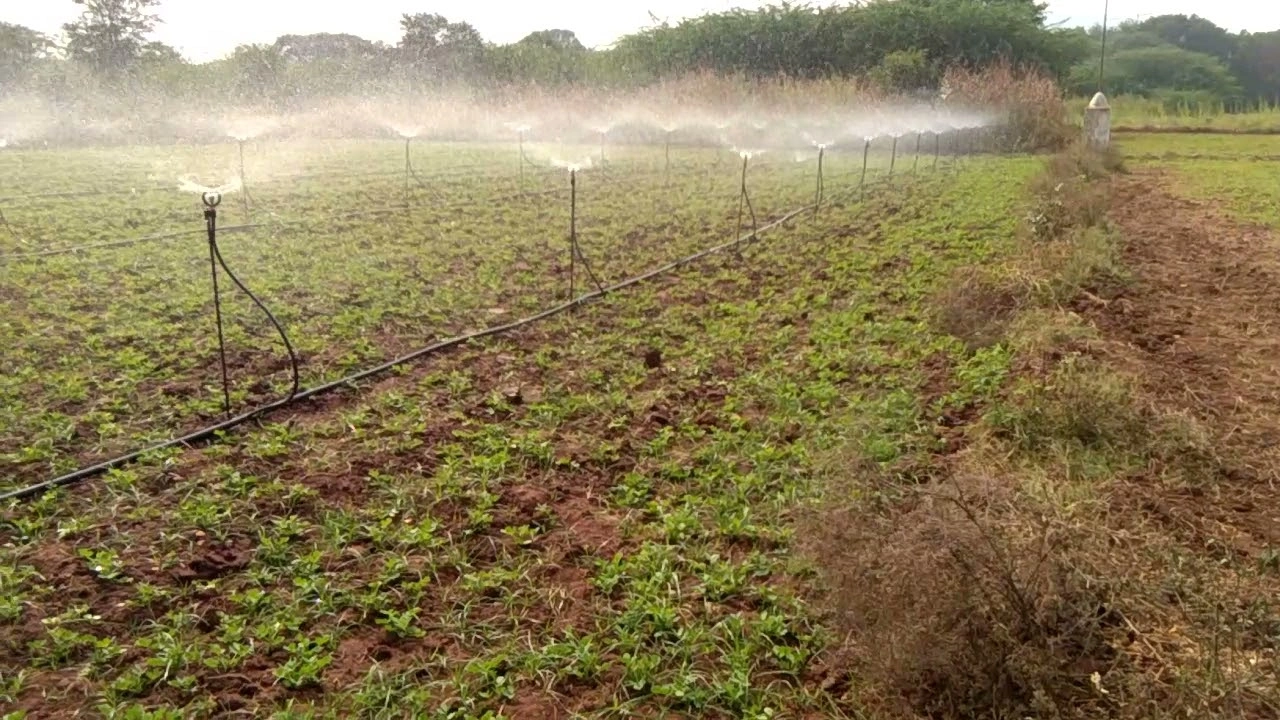
When people search for Agricultural irrigation sprinklers, Farm irrigation systems, or Irrigation system sprinkler installation, they are usually talking about a system that pushes water through pipes and sprays it across the crop like controlled rainfall.
That can mean several different setups. Some are small and portable. Some are mounted on wheels. Some are used on medium fields. And some are huge automated systems that move across large farms.
The main idea is simple. Water is applied under pressure through nozzles, pipes, or rotating heads so the crop gets more even coverage than it would from manual watering or poorly managed flood systems. The USDA NRCS describes sprinkler irrigation as the application of water in spray form through pressurized flow.
The main types of sprinkler irrigation systems in agriculture
This is where many articles get messy, so let’s keep it simple.
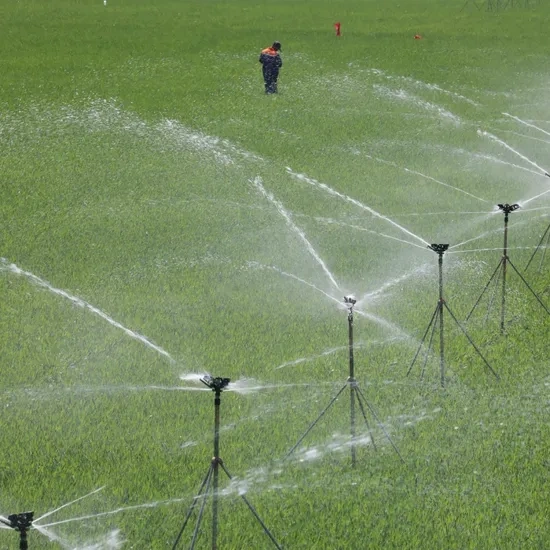
Portable sprinkler irrigation system for agriculture
This is the setup many smaller operations consider first. It can be moved from one part of the field to another. It is useful when the grower wants flexibility and does not want to commit to a permanent system right away.
This can be a good fit for smaller farms, temporary growing areas, or growers testing irrigation before investing more. The downside is labor. Someone usually has to move it, monitor it, and keep the layout working correctly.
Farm sprinklers on wheels
These are similar in spirit. They are movable, practical, and often used where flexibility matters. They can work well when the field layout changes or when the grower wants a system that is not fixed in one place.
The tradeoff is that convenience on the front end often means more labor through the season.
Solid-set or semi-permanent sprinkler systems
These stay in place or mostly stay in place. They are more stable and can save labor compared with fully portable options. They are often a better match for farms that want more regular coverage and less daily movement.
Center pivot irrigation
When people think of Large farm irrigation sprinklers, this is usually what they picture. A center pivot rotates around a central point and waters a large circular area. Texas A&M notes that a quarter-mile system typically irrigates around 120 acres, while longer systems can irrigate much more.
This is one of the strongest choices for big, open fields because it reduces labor and can cover a lot of ground. Michigan State University also provides cost examples showing how operating costs are often considered on a per-acre-inch basis, which is one reason pivot systems are often evaluated for efficiency over large areas.
Lateral move systems
These are similar to pivot systems, but instead of moving in a circle, they move across the field in straight lines. They work best on large rectangular fields. They are efficient, but they are also more specialized and usually require a stronger budget and more planning.
So what is the best irrigation sprinkler system?
Here is the most useful answer.
The best irrigation sprinkler system for Modern irrigation systems farming is the one that matches your farm’s real conditions.
If you want the quick version, here it is:
For small to medium farms that want flexibility, portable or semi-permanent sprinkler systems can be a smart option.
For large open farms, center pivot systems are often the strongest long-term choice because they cover big acreage with less labor.
For high-value crops or water-sensitive areas, drip or micro irrigation may actually be better than traditional sprinklers because water goes closer to the root zone. USDA classifies drip and micro systems as pressurized irrigation too, and they are often chosen when water efficiency is a top priority.
So if someone asks, What is the best agricultural irrigation sprinkler? the better response is, Best for what kind of farm?
That is the question that leads to a useful answer.
Real-world pain points farmers deal with
Let’s talk about actual farm problems, because this is where decisions get real.
A small grower may say, I cannot afford a giant system, but I also cannot keep dragging hoses around all season. In that case, a portable sprinkler system may be a practical starting point, especially if the goal is to improve coverage without making a massive investment all at once.
A medium-size grower may say, My field is too big for a basic movable setup but I do not want the cost of a pivot yet. A semi-permanent sprinkler system may fit that situation better.
A large farm operator may say, “Labor is killing me, and I need something that covers more acres consistently.” That is where pivot systems usually become very attractive.
Another grower may be farming in an area where water is tight and every drop matters. In that case, traditional sprinklers may not be the best answer at all. Drip could win because it reduces losses from evaporation and deep drainage when designed and managed properly.
That is why the word “Best” only makes sense when it is tied to a real scenario.
Uses of sprinkler in agriculture
Sprinkler systems are used in agriculture because they can help growers do several important things at once.
They can improve the uniformity of water application, especially compared with uneven manual methods.
They can reduce some labor compared with constantly moving water by hand.
They can be adapted to different farm sizes, from smaller movable setups to large mechanized systems.
They can support crops that need more regular moisture over the season.
NRCS guidance and irrigation planning materials focus heavily on planning, design, management, and evaluation because the success of a sprinkler system depends on more than simply buying equipment.
That matters because a badly designed sprinkler system can waste water almost as easily as an outdated one.
Agricultural irrigation sprinklers price: what should you expect?
This is the part people care about most, and it is also the part where a lot of websites get sloppy.
The truth is that Agricultural irrigation Sprinklers price varies a lot. It changes based on acreage, water source, pump needs, pipe size, pressure requirements, terrain, automation and labor.
For large center pivots, Texas A&M has published older but still useful benchmark figures showing that a quarter-mile system irrigating about 120 acres typically costs around $325 to $375 per acre, while longer systems may drop to roughly $200 to $250 per acre, excluding well construction, pumps, and power units. Those figures are not a universal 2026 price quote, but they are still helpful as a planning reference because they show how size changes per-acre cost.
Michigan State University also shows that operating costs for a 160-acre pivot example include power and labor on a per-acre-inch basis, with example ranges of $2 to $7.50 per acre-inch for power and $1 to $3.50 per acre-inch for labor. Again, that is not a flat quote for every farm, but it gives you a grounded way to think about annual running cost, not just installation cost.
So if you are searching things like Professional agricultural sprinkler system installation cost near me, cost of sprinkler system per acre and irrigation system sprinkler price, the safest answer is this: you need a site-specific estimate. The real number changes too much from farm to farm for any honest contractor or article to give one universal price.
What affects irrigation system sprinkler installation cost?
A lot of people think price depends mostly on acreage. Acreage matters but it is not the whole story.
Your cost also changes based on your water source. Pulling from a reliable nearby source is different from building around a deeper well.
Your field shape matters too. A wide open, uniform field is easier to irrigate than broken or irregular land.
Elevation matters. Pressure requirements change.
Automation matters. Basic systems cost less than systems with advanced controls and variable rate technology. Utah State University notes that variable rate irrigation upgrades can add meaningful upfront cost, though they may create management benefits in the right conditions.
And then there is installation quality. A cheaper install is not a bargain if it causes poor coverage, high maintenance, and repairs later.
What about DIY installation?
Some people search for things like Irrigation system sprinkler installation manual or “how much does it cost to install a sprinkler system yourself.”
For home lawns, DIY can make sense in some cases. For agricultural systems, it is a different story.
A farm system has to be planned around pressure, flow, nozzle layout, coverage, crop needs, and future maintenance. NRCS irrigation guidance emphasizes planning and design because this is engineering work, not just assembly.
That does not mean a farmer cannot do parts of the work. Many do. But going fully DIY on a serious farm irrigation system without proper design can create expensive problems later.
How to choose the right farm irrigation system
If you want a practical decision framework, start here.
Ask how much land you need to irrigate.
Ask what crop you are growing and how sensitive it is to uneven watering.
Ask how reliable your water supply is.
Ask how much labor you can realistically manage during the season.
Ask whether your priority is lower upfront cost, lower water use, lower labor, or long-term scalability.
If your priority is lower upfront cost and flexibility, a portable sprinkler setup may be the right first move.
If your priority is covering large acreage efficiently, center pivot becomes much more attractive.
If your priority is maximum water efficiency on valuable crops, drip deserves serious attention.
That is what “modern farming” really means in this conversation. It means choosing based on data, conditions and long-term return instead of just copying what another farm did.
The best way to turn this into a buying decision
By now, the big idea should be clear.
The best irrigation sprinkler system is not the one with the biggest name or the fanciest brochure. It is the one that fits your farm and gives you better control over water, labor, and crop performance.
If you are still comparing options, the next smart step is to get a real field-based assessment. Look at acreage, crop type, water access, pressure needs and future operating cost. That will tell you more than any generic online price list ever will.
And if you offer irrigation services, this is where your article should naturally lead the reader: not with a pushy sales line, but with a useful next step. Something as simple as, “If you want help choosing the right agricultural sprinkler system for your farm, get a site-specific estimate based on your field layout, water source and crop needs,” works because it matches the reader’s real concern.
FAQ: real questions farmers actually ask
What is the best irrigation sprinkler system for modern farming?
The Best irrigation System depends on your Farm size, Crop type and Water availability. Drip irrigation is Best for water saving, sprinkler systems are best for flexibility, and center pivot systems are best for Large Farms
What is the price of agricultural irrigation sprinklers?
The Cost of agricultural irrigation Sprinklers depends on land size, system type and installation complexity. Small systems are more affordable While large farm systems like center pivots cost more But cover larger areas Efficiently
What is the cheapest irrigation system for farming?
Sprinkler Systems are usually More Affordable than Drip and Pivot systems, Making them a Common choice for Small to Medium Farms
Are portable sprinkler irrigation systems good for agriculture?
Yes, portable sprinkler systems are Good for Small farms or flexible irrigation needs But they require more labor compared to Fixed Systems
How much does sprinkler system installation cost per acre?
The cost varies depending on the system type, water source, and design. Large systems may cost more upfront But Provide better efficiency Over time
Final thought
If you came here hoping for one simple answer, here it is in the most honest form:
The best irrigation sprinkler system for Modern irrigation systems farming is the one that helps your specific farm use water more wisely, cover the field more evenly and stay profitable over time.
For a smaller operation, that may be a portable or semi-permanent sprinkler system.
For a large open field, that may be a center pivot.
For water-sensitive or high-value production that may be drip instead of a traditional sprinkler.
The smartest move is not chasing a trendy system. It is choosing the system that matches the reality of your land, crop, water supply and budget.